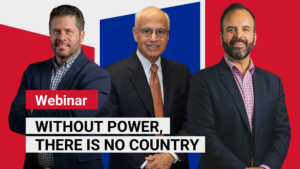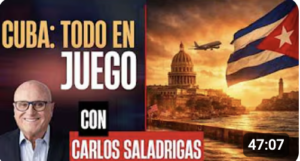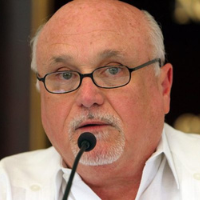
This 23yFlagler program brought together Carlos Saladrigas, Cuban-American businessman and co-founder of the Cuba Study Group, to analyze whether the Trump administration’s policy toward Cuba could lead to a new period of economic opening comparable to the rapprochement driven by Barack Obama between 2014 and 2016. The Cuba Study Group, founded in 2000, has played a very active role in bringing Cuba and the United States closer together, and exerted significant influence on the Obama administration to achieve the advances made during that period. Saladrigas, with more than two decades of work in favor of Cuba’s economic opening, offers in this conversation a historical assessment and a roadmap for the future.
The central focus of the debate was the question of whether the Obama thaw worked or not. For Saladrigas, the answer is unequivocal: the process failed by deliberate decision of the Cuban regime, not due to failures on the U.S. side. According to Saladrigas, the process faltered because the Cuban government simply refused to let it work, and began rolling back its own economic reforms even before Air Force One had left Havana’s airport. The historical responsibility, in his analysis, falls entirely on Havana: the only ones to blame are the Cuban leaders who made terrible decisions or lacked the courage to make the necessary ones.
“Obama opened the door to progress, opened the door to change, presented a very elegant solution for the Cuban leaders, for the Cuban people, a magnificent solution that fully exercised our sovereignty, and the government refused to accept it.”
On Biden’s posture, Saladrigas was equally blunt. He described Biden’s decision not to resume the thaw as “political cowardice,” and characterized the Trump administration’s stance on negotiations with the Cuban regime simply as “pragmatism.” This distinction is key to the interview: for Saladrigas, the method matters less than concrete results for the Cuban people, though he lamented that Cubans have no direct agency in the process.
The conversation also addressed the debate over sanctions and the embargo. Saladrigas was categorical: “It is impossible, impossible for the Cuban economy to recover under these sanctions,” stressing that their complete lifting is an essential condition for any recovery. At the same time, he welcomed certain concrete signals from the Trump administration — such as the February 25 authorization for the direct sale of U.S. fuel to Cuban private microenterprises, bypassing the embargo — describing it as a pragmatic first step in the right direction. On the prospect of the diaspora investing in Cuba, Saladrigas considers it necessary, but warned that the Cuban government would need to resolve many legal uncertainties and openly declare its willingness to abandon centralized socialism and adopt market-based measures.
Saladrigas also laid out his vision for a post-transition Cuba, structured in three phases. The first is stabilization, lasting between 2 and 4 years and costing between $6 billion and $10 billion, financed primarily by the Cuban diaspora and the U.S. government through a Marshall Plan-style program. The second phase would involve rebuilding infrastructure — ports, roads, water systems — over approximately five additional years. The third would be the strategic vision: transforming Cuba into a major Caribbean financial hub comparable to Singapore within 10 to 15 years, centered on the digital economy, artificial intelligence, medical tourism, and research and development.
Finally, the program addressed the risks of a disorderly transition. Saladrigas warned that the greatest danger of a chaotic change would be the infiltration of Latin American drug cartels into Cuba: “If this change happens chaotically, the risk of narcocrime infiltrating Cuba is very high.” For him, the fundamental question is not whether the United States should lead the change, but whether it can create the conditions for Cubans themselves to define their own destiny. Against a backdrop where Cuba’s GDP fell 5% in 2025, accumulating a 15% decline since 2020, and the Cuban peso depreciated 47.8% against the dollar in the past year, Saladrigas sees the current moment — despite all its hardship — as the greatest opportunity the Cuban people have had to build a different country.